Zhongshan (中山) / Hsiangshan (香山)
Date Published
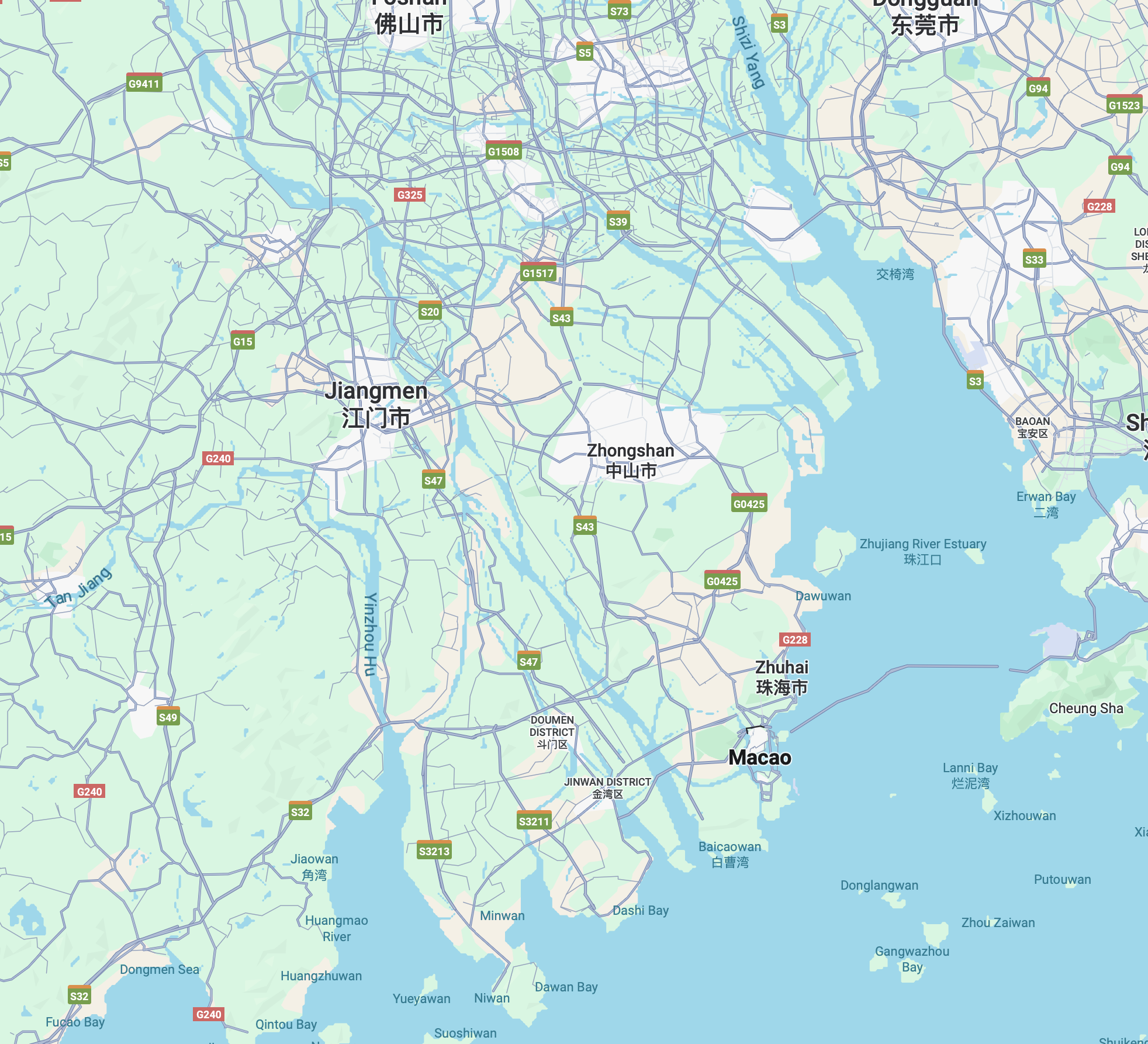
A major contributor to the history of the Chinese overseas was Zhongshan (中山) County, known as Xiangshan or Heongshan (香山) until 1925. It was divided into nine localities and a census of 1910 reported the total population to be more than 820,000. Sydney, Hawaii and San Francisco were the most popular destinations for people from Zhongshan, though the single locality of Long Du seems to have contributed as much as all other Zhongshan areas combined. Long Du, for example, was also one of the few localities (possibly the only one) that had sufficient numbers to organise its own associations in all three of these Pacific Ports.
Estimates of the proportions of village members involved in travel to Australia and other places are difficult due to the rarity of statistics and because of the great variations between villages and localities. The Rev Damon of Hawaii, a visitor to Zhongshan in 1884, gives the impression that the proportions were quite high: ‘One long day’s walk of many miles, enabled us to pass through village after village from which people have gone out to the Hawaiian Islands or other parts of the world. It was very strange every now and then to have a man look up from his work in the field, or run out from a shop to greet us in English or Hawaiian’. In the 1890s it was said of the village of ‘Háng Míe’ that one third of the village was returned from Sydney. The Long Du village of Chung Kok had at least 220 members living overseas in 1913 out of 2,300 families or perhaps 10% of its working male population. Chung Tou, another Long Du village and one with nearly 1,400 households in 1910, reported having almost 330 village members resident around the Pacific in 1948, or at least 20% of its working males.
The income from having some many people earning overseas naturally had a great impact on Zhongshan. The Rev Damon again in 1884 reported that; ‘Many new homes at different points had been built by these returned labourers who had earned enough abroad to give their family thus a decent home. The dwellings are all of one storey.’ Donations were often made therefore for health clinics, schools, street lights, reading rooms, tea pavilions, community buildings, village watch towers and bridges. As a result of these earnings and donations coming into the villages over the generations many changes occurred and villages with high proportions of members overseas were easily distinguished from those without.
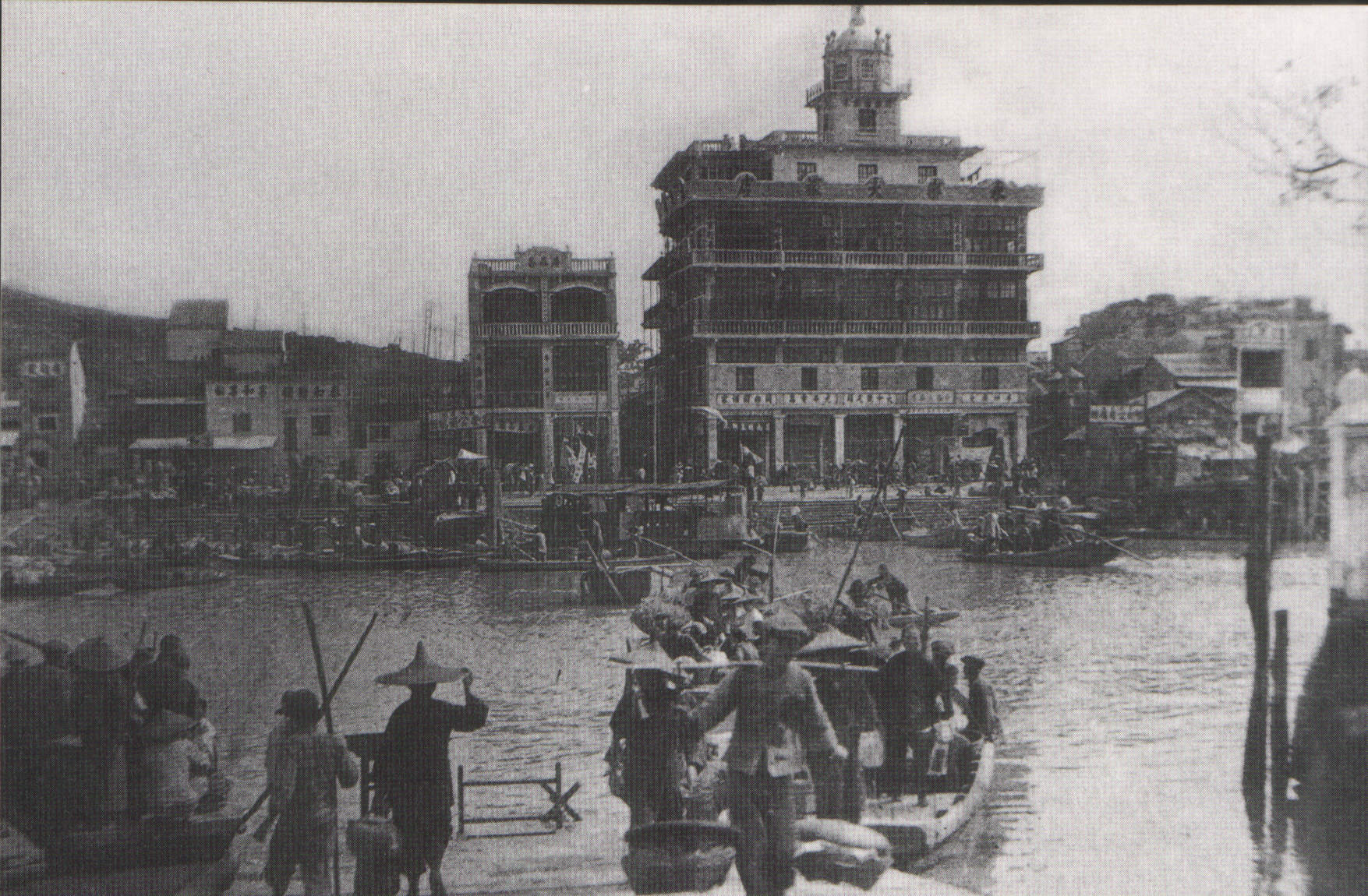
Many businesses were also established in county capital Shekki by those who had been overseas. That the Kwok and Ma families of Zhongshan and Sydney used their capital to found the large Hong Kong and Shanghai based businesses of Wing On and Sincere is well known. However the Wing On and Sincere companies also had a branch store each in Shekki. Many other stores in Australia and elsewhere also opened branches in Zhongshan to facilitate the operation of remittance services. The Kwong War Chong of Dixon St, Sydney for example, had branches in both Hong Kong and Shekki. While Zhang Bing-chang, a Sydney herbal shop owner for many years, put capital into his Sydney educated son’s Shekki Department Store in the 1920s. By the 1930s, the main street of Shekki was lined with pawn and gold shops and other businesses associated with the need to exchange foreign currency.
However, most of these businesses were designed to facilitate consumption rather than production and dependence and consumerism was often the main consequence of years of overseas earnings. Efforts were made to promote more productive investment such as a port designed to bypass dependence on Portuguese controlled Macao, but in general social and political disruptions made such investments risky. Social changes were also attributed directly to the influence of those who had gone overseas. In 1920, for example, an essay published in a magazine aimed at those overseas complained that there was ‘no more the sound of shuttles flying, no more embroidery.’ ‘Household members all looked for support from overseas,’ ‘speaking fancy vocabularies, wearing modern clothing and much jewellery’, and going ‘once every three days to Shekki’.
For those educated by money from Australia and elsewhere, labouring work was no longer an option while at the same time there were few other alternatives. Many sons of those overseas found low paid teaching jobs to be one of the few avenues they had in the villages. An alternative for those without land or education was banditry and such bandits naturally made the wealthy a target and those with access to overseas incomes were a prominent one. The building of watchtowers and the creation of local village guards troops for protection were increasingly necessary and those with funds to protect were naturally expected to contribute to such measures. In Zhongshan today the houses of those who travelled overseas can often be recognised by the presence of a ‘tower house’.
The impact of the long history of overseas travel by Zhongshan’s people can be seen in its landscape today. Not least in the high number of modern industries established in this prosperous part of China with overseas capital, very often by the descendants of the same people who traveled overseas and sent money to Zhongshan’s villages in the nineteen and early twentieth centuries.
Source: Michael Williams, Returning Home with Glory, HKU Press, 2019.
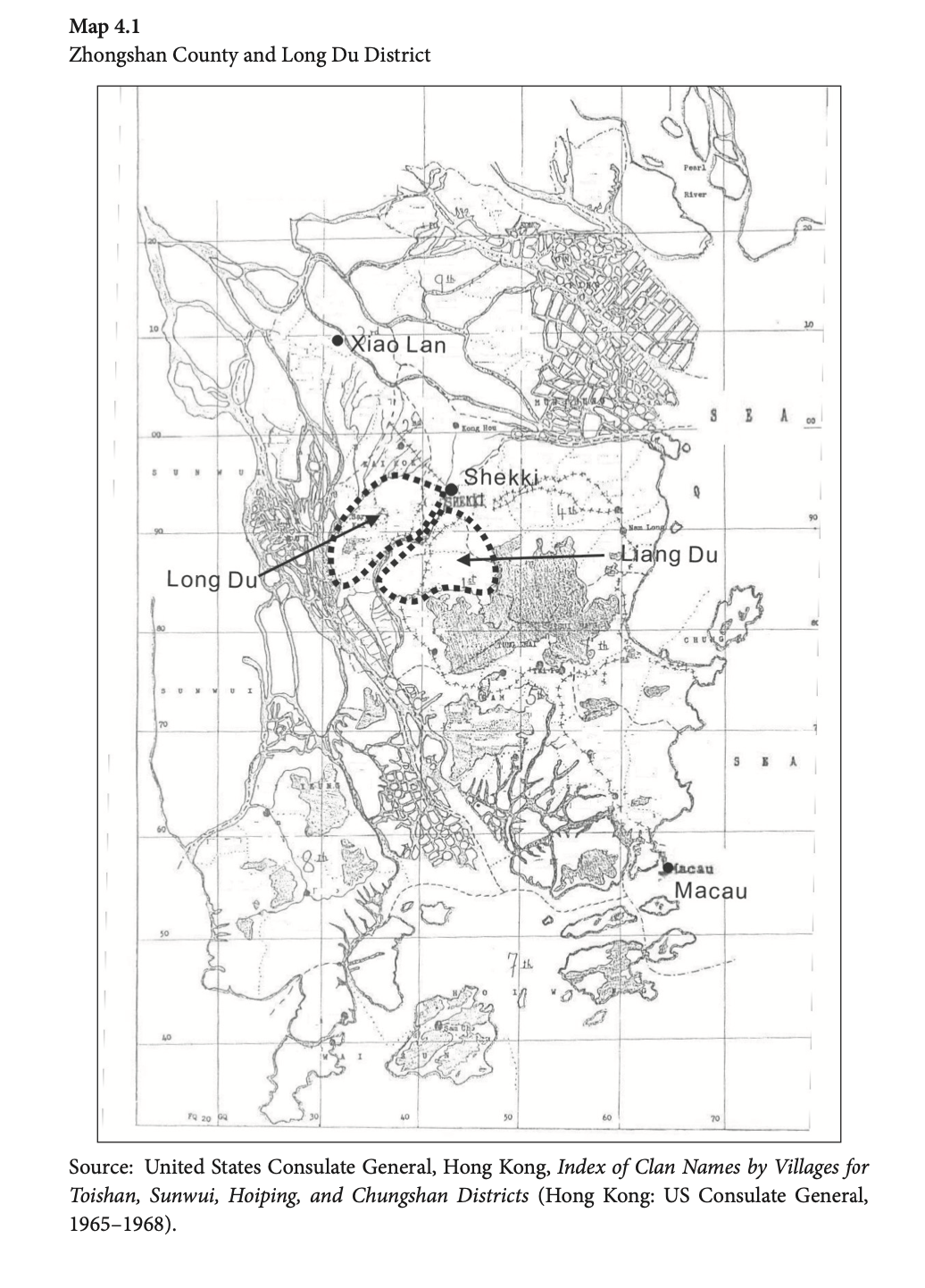
US Consulate Map