Market gardening
Date Published
A general overview of marketing gardening as conducted by Chinese people in Australia
"As mining became less profitable in the various colonies from the 1870s onwards, market gardening became the next most common Chinese occupation. At this time European Australians avoided market gardening which provided a niche for the many Chinese in Australia with agricultural backgrounds. By the 1900s approximately one third of all Chinese in Victoria, New South Wales and Western Australia were engaged in market gardening. Even before this Chinese on the gold fields grew their own vegetables and those in market gardening at this time possibly made more money than those mining gold.
Market gardens tended to be located in the city suburbs. Chinese communities, like the one in Alexandra, Sydney, often grew up around them. In Melbourne there were market gardens along Merri Creek and in suburbs such as Brighton and Caulfield. In Western Australia they tended to be around Perth and in Fremantle along the Swan River. In the Northern Territory the Chinese grew the bulk of fresh produce for Darwin on the outskirts of town and in the Pine Creek area. In north Queensland Chinese market gardening was really more on the scale of farming with Chinese specialising in bananas and sugar and even experimenting with rice, corn and lychees.
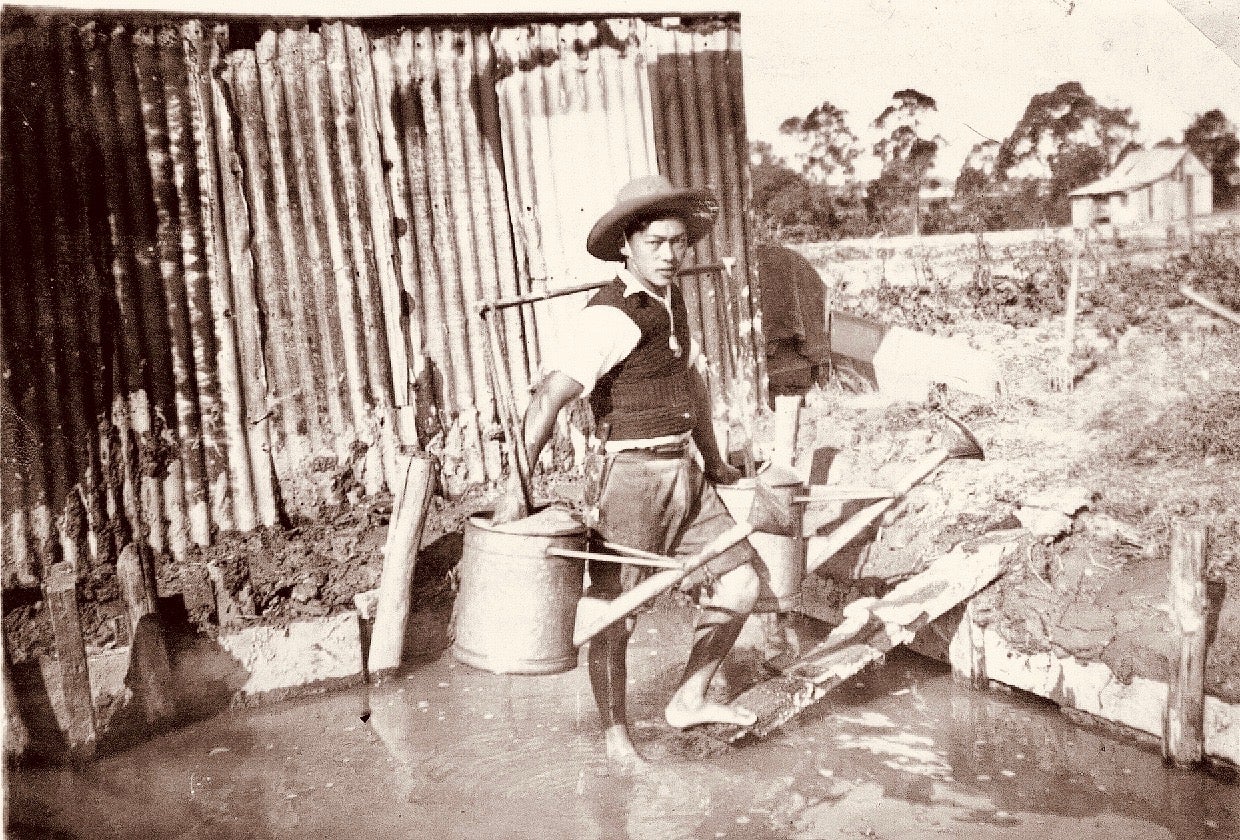
Chinese market gardens tended to operate on a cooperative basis with as many as ten workers, often from the same clan. There were close ties between market garden cooperatives and urban Chinese storekeepers and greengrocers who helped provide gardeners with credit or financial support. Using hand made tools market gardeners worked long hours in this very labour intensive industry. Crop rotation and double cropping methods were used to grow a range of produce including tomatoes, cauliflower, herbs, leafy vegetables like lettuces. Produce was sold either direct to the market or else through a commission agent who sold the produce on the gardeners' behalf. Although Chinese market gardeners and hawkers are seen as synonymous, due to the high labour intensity of both activities it is unlikely that an individual could perform both concurrently. As in other industries where the Chinese were successful,
Chinese market gardeners also faced opposition from their European counterparts. In 1900 a Market Gardeners' Association was formed partly in opposition to Chinese competition. During the depression others resented the fact that the Chinese were able to make money out of 'incidental' crops which non-Chinese found uneconomical. Chinese market gardeners were accused of using urine and faeces to fertilise their gardens and of living in insanitary conditions. As the Chinese population in Australia declined so too did Chinese market gardeners. The Greek and Italian community started to move into the industry, particularly after World War II. However it was not until at least the 1950s, possibly later, when the last of the original Chinese market gardens finally disappeared.
Sources used to compile this entry: Bate, Weston, A History of Brighton, Melbourne University Press, Melbourne, 1983; Broome, Richard, Coburg: Between Two Creeks, Lothian Publishing, Melbourne, 1987; Chou, Bon-wai, 'The sojourning attitude and the economic decline of Chinese society in Victoria, 1860s-1930s', in P. Macgregor (ed.), Histories of the Chinese in Australasia and the South Pacific, Museum of Chinese Australian History, Melbourne, 1995, pp. 59-74; Cronin, Kathryn, Colonial Casualties: Chinese in Early Victoria, Melbourne University Press, Melbourne, 1982; Fitzgerald, Shirley, Red Tape and Gold Scissors: The Story of Sydney's Chinese, State Library of NSW Press, Sydney, 1996; Ryan, Jan, Ancestors: Chinese in Colonial Australia, Fremantle Arts Centre Press, Fremantle, WA, 1995; Shun Wah, Annette & Aitkin, Greg, Banquet: Ten Courses to Harmony, Doubleday, Sydney, 1999.
Sophie Couchman:
Demographically and economically the Chinese presence in southern and western NSW was significant, and evidence of an important pattern of migration lasting for many decades from the goldfields to rural areas and rural occupations. The primary reason for this migration in the Riverina and western NSW was the opportunity presented by an expansion of pastoralism, itself partly driven in the area north of Hillston by a mineral boom, which lasted for almost forty years. Most Chinese were employed on land clearing contracts; others were engaged in business activities such as commerce and market gardening. The numbers of Chinese engaged in the latter occupation were small compared to those engaged in land clearing, but their gardens were an essential part of town and country life, supplying fresh fruit and vegetables not only to themselves but to pastoral stations, mining communities and other towns. In many instances it would be difficult to contemplate a more forbidding and unfriendly physical environment, but they turned these impediments to advantage. Their perseverance and success surely earns them the long-denied accolade of pioneer.
Barry McGowan: https://australianhumanitiesreview.org/2005/07/01/chinese-market-gardens-in-southern-and-western-new-south-wales/
"Examples of major Chinese market garden “Cultural precincts” associated with regional north Queensland towns include the gardens at Camooweal along the Georgina River, the garden area at Cloncurry along the Coppermine Creek, garden areas at Georgetown along the Etheridge River, garden areas near Winton at Pelican waterhole and Mistake Creek, Lee See’s and Ah Hon’s syndicate gardens at Hughenden along the Flinders River, Woods Lake near Burketown and a large garden area at Lawn Hill Station (see Chapter 9). Other small garden areas which could be noted as dedicated cultural precincts include Ah Toy’s garden on the Palmer Goldfield, Market Garden 31 at Georgetown on the Etheridge River,472 and the shop and garden complex associated with Willie Mar Senior and Willie Mar Junior at Winton."
Sandi Robb, North Queensland's Chinese family landscape: 1860-1920. PhD Thesis, James Cook University. 2019, pp.114-115.
"The soil at his place is a rich black loam, has been trenched two feet deep, and is well manured with stable refuse, and yields enormously in favorable seasons. But if we are going to have a series of good seasons like the present what will become of the Chinese gardens. In the ordinarily dry weather John does very well; he works hard, and goes to no end of trouble in rigging up Californian pumps and providing other appliances for drawing water for irrigation, and his labor is well rewarded, for good prices are obtained for his produce. The European waits on Providence for a good season, and when it comes the yield is enormous and prices come down very much below what the Chinese can make remunerative. Consequently his business suffers, but he takes it very philosophically-"All right this year; plenty more dry; weather by and by, make it all the same."