Yoke, Bathurst
Date Published
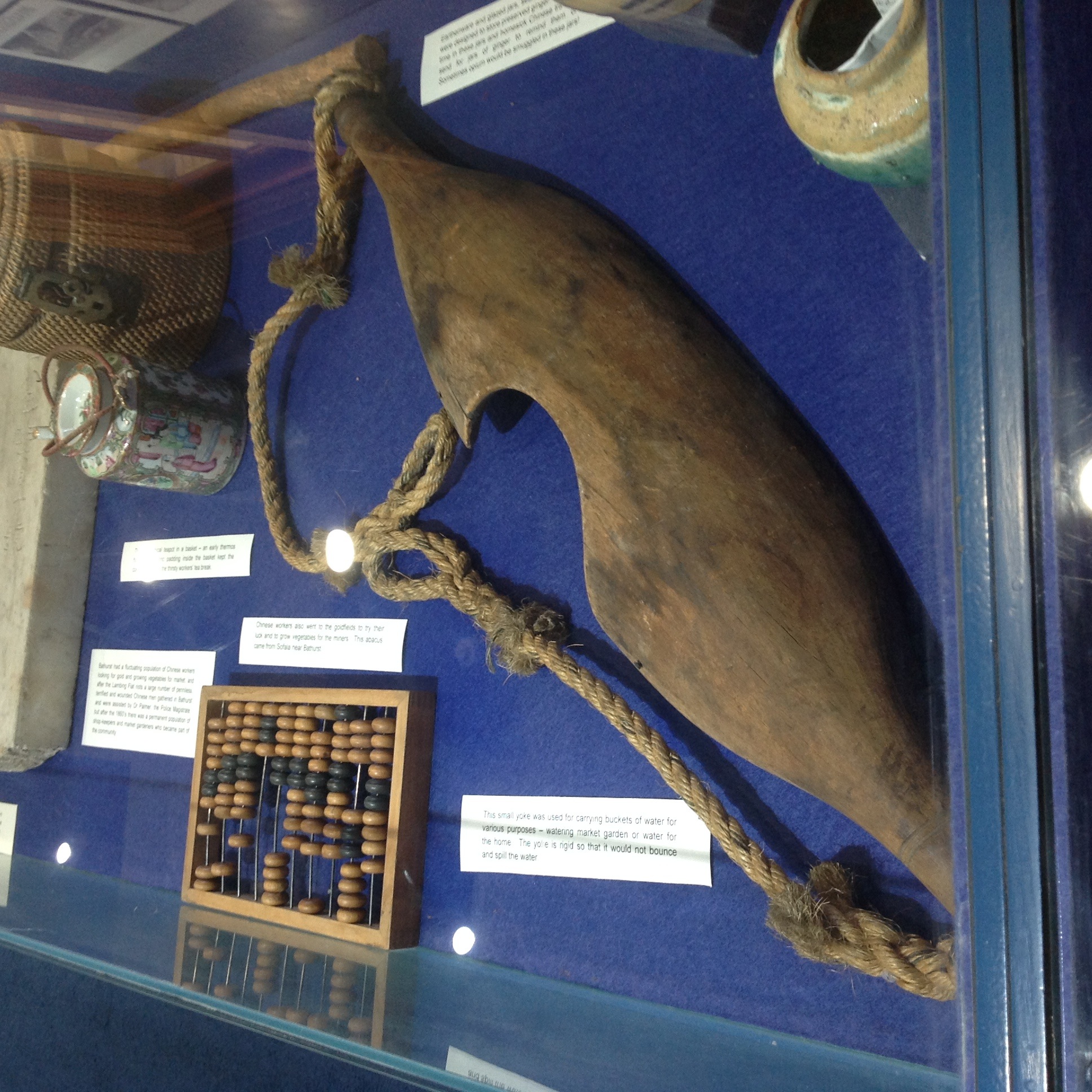
: myths, market gardening
: Central Tablelands (NSW)
: Bathurst
: c.1900
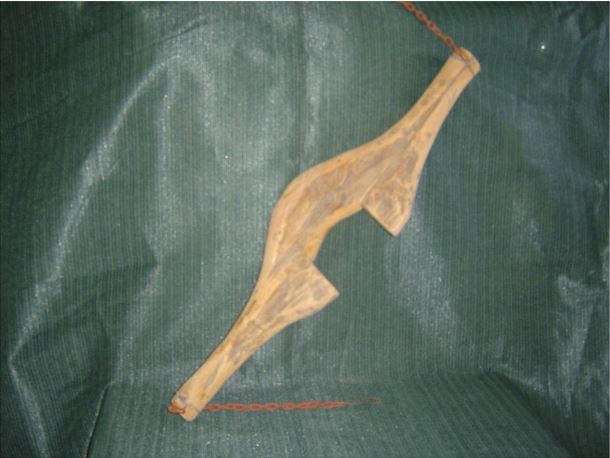
Wooden yoke made in European style mistakenly attributed to Chinese.
Yoke
This yoke is on display in the Bathurst Historical Society Museum and while it doesn’t say it is a ‘Chinese yoke’ it is in the ‘Chinese’ display case along with other objects associated with Chinese people. A number of similar (neck/shoulder) yokes are to be found in local history museums and many if not all are labelled ‘Chinese’. This labelling is all the more remarkable in that any number of pictures exist that show Chinese people carrying loads on a ‘shoulder yoke’, all of which are of the flat pole type that rests on one shoulder only.
There is one image of a Chinese man using the ‘two shoulder’ or neck yoke among the many that show a variety of non-Chinese people using them. Perhaps what has occurred is a mass amnesia about anyone in Australia other than Chinese people using yokes? Something along the lines of: ‘using a yoke is hard work, we know the Chinese worked hard, therefore this is a Chinese yoke’.
Any good post-modernist will tell you that the myths a people tell are as informative as the ‘facts’ an obsessive historian likes to cling to. That the type of yoke pictured is so often associated with Chinese people tells us that the stereotype of ‘hardworking’ dominates.
Another point of interest is that Americans, at least on their east coast, have no trouble associating this yoke type with Europeans and European-Americans. Presumably because of a relative lack of an historical ‘memory’ of Chinese people carrying loads on any variant of yoke or pole.
Nevertheless, at least two Bathurst locals claim to have seen Chinese people use the yoke type pictured. This raises two interesting possibilities:
1) That Chinese market gardeners, etc., did adapt to the use of the ‘two shoulder’ yoke – whether purchased or made by themselves. (This is suggested by Joanna Boileau, All that glitters is not gold: The Chinese in the Banana industry in Northern NSW, 1916-1926 (November 2009, UNE, Armidale), pp.30-31.)
2) That memories conflate and yokes are being attributed according to a stereotyped imagining.
For an example of a recognised yoke of European origin see Victorian Collections - Yoke 19th century
Memorial image taken at Chinese Cemetery Cloncurry, Robb Private Collection, 2007 - use of Chinese style yoke
p.260
.png?2025-11-10T20:32:20.362Z)