Opium
Date Published
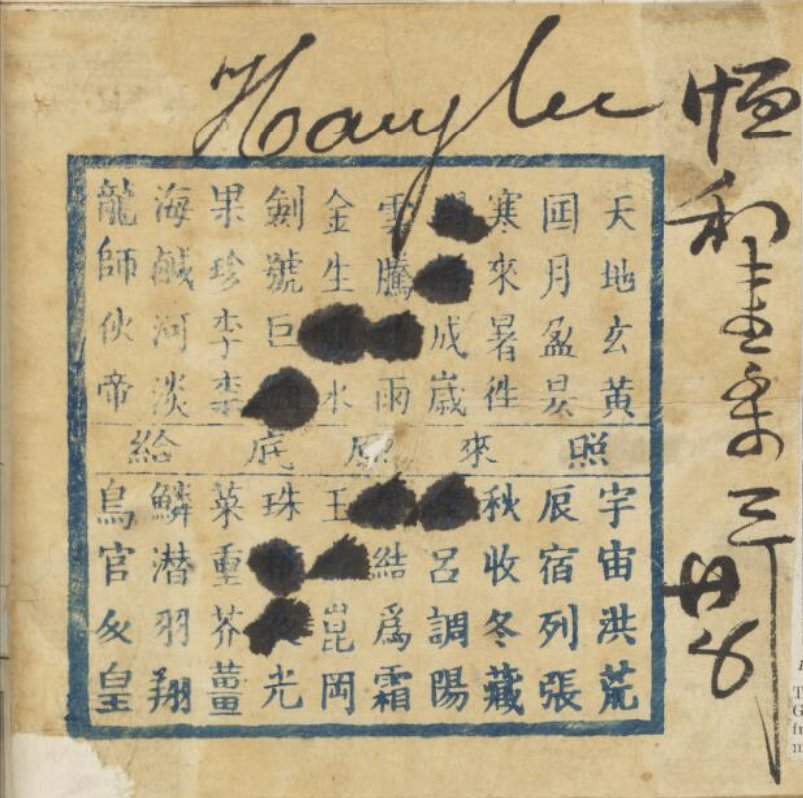
The consumption of opium was common by Chinese people and legal until the early 20th century.
The association between Chinese people and opium was as strong as that between Europeans and alcohol. When for example John Dundas Crawford1 was making his investigative tour of Chinese people in Australia in 1877 on behalf of the British government he attempted to use the amount of opium imported into the colonies (on which a tariff was paid) as a means of calculating an accurate estimate of Chinese numbers in the British colonies of the Australian continent.
Nevertheless opium and what were invariably referred to as "opium dens" increasingly became a measure of the degradation of Chinese people. This is especially the case when European Australians were also seen to be indulging. For the Chinese Australian elite anxious both to see China strong again and to stave off the threat of a White Australia opium was seen as debilitating on a number of levels.
By the end of the 19th century many had begun to agitate for making opium consumption illegal, as many others were also doing at this time for alcohol. But while the anti-alcohol movement succeeded only in limiting pub opening times, that against opium saw its importation prohibited in 1906. It was likely the fact that mostly, though by no means exclusively, it was Chinese people who indulged in opium that made this ban more successful that that against the European favoured alcohol. As many prominent members of the Chinese Australian community supported this ban, and Chinese Anti-Opium Leagues were formed in many states to request its prohibition.
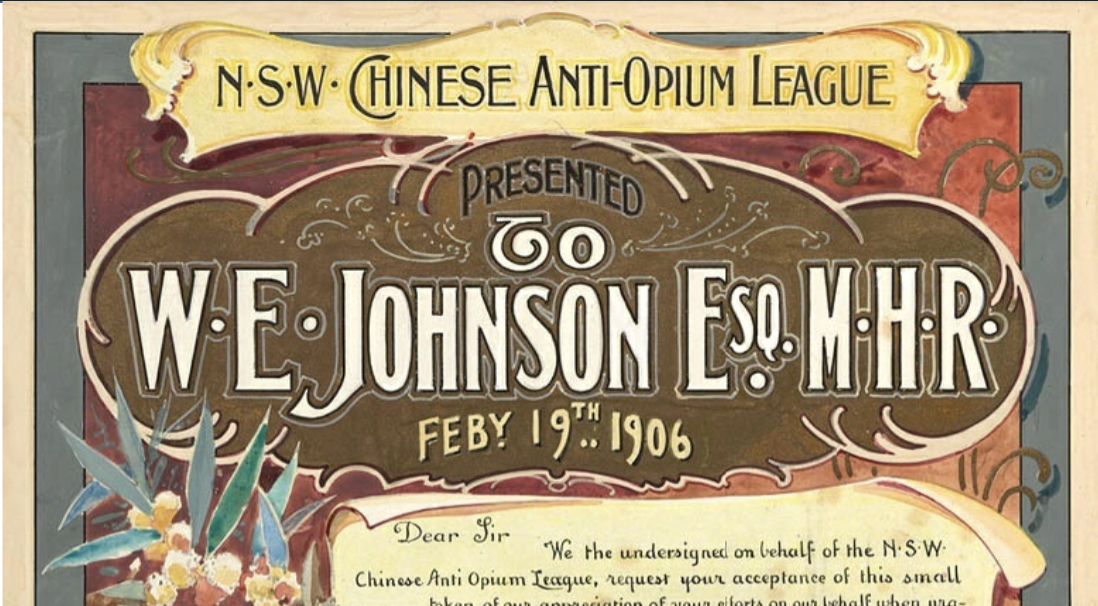
The “illuminated address” presented at a banquet held at the popular A.B.C. Cafe in Pitt Street, Sydney was in celebration of the Australian government’s ban on the importation of opium into Australia – except for medicinal purposes – from the beginning of 1906. This ban, along with supporting legislation at the state level (in Victoria but not NSW at this time), criminalised a drug and its users that had been freely used and taxed in Australia and elsewhere. Nowadays reference to opium invokes images of dirty crowded rooms and helpless addicts or perhaps of the ‘Opium War’ and British determination to run drugs into China. In any event the association will mainly be with Chinese people and more often than not with criminality. Yet the main supporters of this ban and the authors of this address were prominent members of the Chinese Australian community, including some who had made significance profits from the importation of opium.
Of course merely making something against the law did not eliminate a usage and a habit of long standing instantly. Though it did make all who continued to indulge this habit instant criminals. Thus the Chinese community, presumably to the dismay of the supporters of the Chinese Anti-Opium League, found themselves stereotyped as criminals for continuing to use and smuggle a drug that had among other things helped finance the government of Hong Kong and which the British continued at this time to sell in China. The result was to reinforce stereotypes that saw Chinese Australian’s as separate and unwilling or unable to fully integrate into a ‘white’ (alcohol based) society.
See Michael Williams, ‘Observations of a China Consul’, Locality, Vol. 11, no.2, 2000, pp. 24-31.