Veterans Memorial, Chinese Australians
Date Published
: war, memorials
: Sydney
: Sydney
: 2003
Chinese Australian Veterans Memorial, Haymarket, Sydney
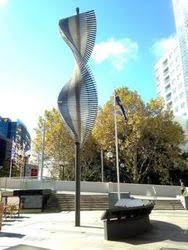
The Chinese Australian veterans memorial, located at the north end of Dixon Street in Sydney’s Haymarket Chinatown, tells us two things of importance. Firstly, it highlights the long history of Chinese people in Australia, and secondly, it informs us that this history is about more than growing vegetables or living in Chinatowns. It is primarily a commemoration of service to the nation by those who identified, or can be identified, as of Chinese heritage. This memorial is the work of members of the Chinese Australian community who felt that their service had not been sufficiently recognised.
Serving one’s country in war is considered by many to be the ultimate expression of national loyalty. Certainly Australia spends a great deal of energy commemorating ANZAC Day and the service of veterans in general. Yet the appeal to war service as proof of national loyalty and even national identity can be divisive even as it strives to unify. The reasons for this are fundamentally the same as the ongoing issues with “Australian history”. This history is all too often written as a “white” history, with “natives” and “migrants” slipped in at the margins when it suits to appear diverse.
One result of this perspective is that ANZAC and other elements of Australian history are usually told in terms that exclude all but those of obvious white heritage. Communities such as Chinese Australians often find themselves perpetually cast as a “migrant” community, whose contribution to Australian history by definition is assumed to be recent and therefore cannot include war service. To both stake a claim in Australian nationalism and to highlight the deep nature of Chinese participation in Australian history, efforts have been made to highlight Chinese Australian participation as servicemen and women. This participation made all the more poignant when it is remembered that at times people, “not substantially of European race” have been barred or discouraged both legally and socially from joining the armed forces of Australia.
This Sydney memorial is by no means the only such effort. CHINESE ANZACS, published in co-operation with the Museum of Chinese Australian History, is a recent example. While in Brisbane, a memorial has also been erected to Billy Sing, a First World War sniper. In these instances there is a sense of revealing a “hidden” or “forgotten” history. However, it should be noted that to the extent that this “forgetting” is true, it is the fault of later generations, and not of those who served with Billy Sing and his comrades, who were strongly commemorated in their day.
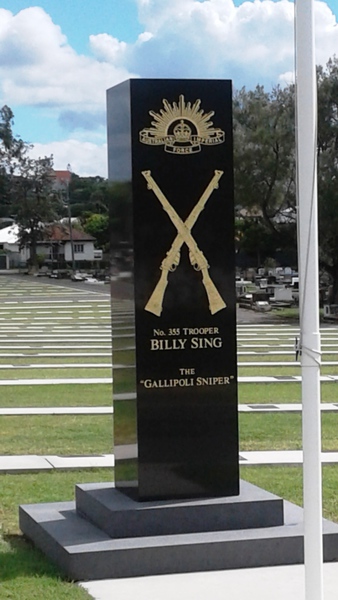
Lutwyche Cemetery, Billy Sing Memorial
Another point worth noting is the issue of identification and self-identification. For many who joined the Australian army, especially at the height of the White Australia policy during the First World War, their Chinese heritage may have been slighted or even possibly unknown to them. Is it correct for researchers of a succeeding generation to assign a person the label “Chinese” or even “Chinese Australian”, when they themselves, regardless of why, did not?
This question of identification is one of the many legacies of the White Australia policy. A policy which should be understood as a psychological project, not merely an immigration policy. The White Australia project was a hugely successful one insofar as it imposed on Australian history and many Australians a sense of race nationalism that requires constant reminders as to the depth of its falsity. Memorials such as those referred to here are reminders of all those of many heritages who served the nation. They also a prompt to review the race myth that for too long was also part of our national history.
See also: Chinese-Australian WWII fighter initially rejected from RAAF because he wasn’t ‘substantially European’