
Scrub cutting
Date Published
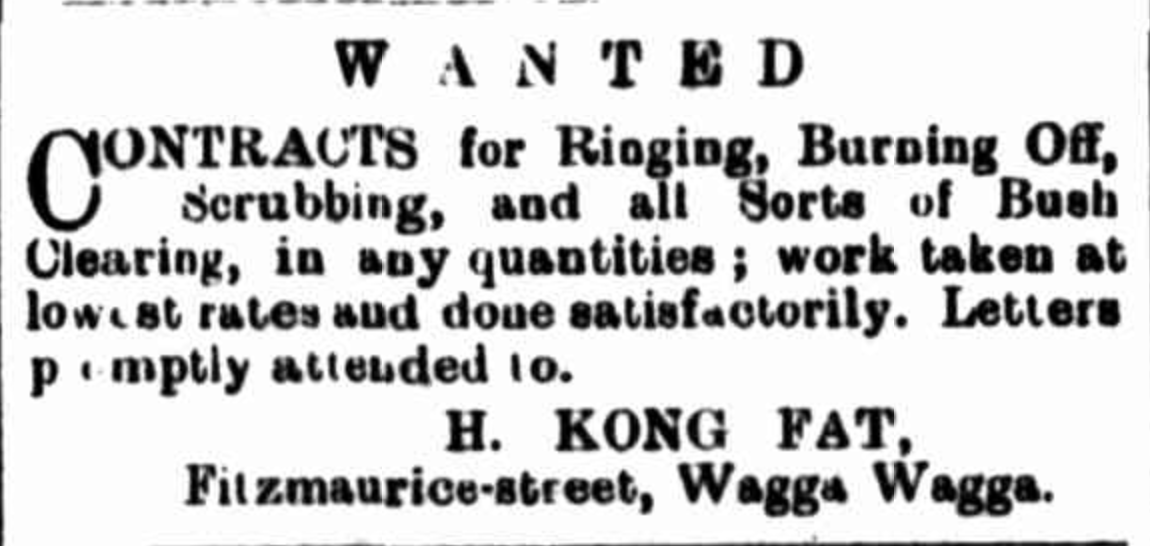
Scrub cutting
Alongside gold mining and market gardening, one of the most important yet least recognised occupations undertaken by Chinese workers in Australia was scrub cutting. Despite its prominence and its contribution to the opening up of large areas of agricultural land, it has received surprisingly little attention in Australian history.
By the late nineteenth century, agricultural and pastoral expansion across New South Wales and Queensland demanded the clearing of vast tracts of bush and scrub. Much of this arduous work was carried out by Chinese contract gangs, organised by Chinese labour contractors who coordinated teams of workers for specific clearing projects. These men often lived collectively in town-based dormitories, moving out into rural districts for weeks or months at a time to complete their contracts.
Prominent contractors such as Harry Hong Fat of Wagga Wagga advertised for work, recruited men, and dispatched them to farms across the region. The work was gruelling and unskilled, but it suited the large numbers of single Chinese men then in the colonies. The Chinese gangs earned a reputation for efficiency and reliability — qualities that made them preferred by many white landowners, who often complained that European labourers were less disciplined and more prone to leaving work unfinished.
In this way, Chinese scrub-cutting gangs played a vital but often overlooked role in transforming the Australian landscape, helping to open new districts to farming and settlement while also establishing an enduring Chinese presence in rural Australia.
J.W. Dennis, of Gonn Station near Deniliquin contracted to £192 10/ have 16 men for clearing and grubbing 8000 acres (3,237 ha). That is a little more than 12 per man or a little more than 5 pence per acre. With the agents cut (who in this case needed to be taken to court) the payment per man would be even less.
The Age, Saturday 6 June 1903, p.9.
https://trove.nla.gov.au/newspaper/article/197225227
Paddy Hing Gook, whose store was set up on the southern side of Cressy Street. In his day Paddy was the "boss man" and titled himself a contractor. In keeping with his status he always smoked the best cigars. It was to Paddy the squatters went when they required cheap mass labour. The Chinese were excellent workers at scrub cutting, ringbarking, clearing or dam sinking. In early days ringbarking could be obtained at 9d per acre, but in later years, around the 1870's the rate had risen to 1/9 per acre. Paddy had a trotting horse "Little Shamrock" , but he never managed to succeed with him. Paddy eventually died at Deniliquin.
Source: John E. P. Bushby, Saltbush Country - History of the Deniliquin District, 1980, p.276.

