Remittances
Date Published
Remittances to family in the villages were a significant part of the lives of Chinese people in Australia before 1949.
"The amount of money remitted naturally varied with the earnings of the individual. Crawford, reporting in 1877, believed that the “average amount so exported [packets of gold dust for relatives] hardly exceeds 1l a-head annually”.33 In 1891, Chow Kum, a carpenter and furniture-maker in Sydney, stated that he sent £20 per year to his wife.34 Yang Rui, a Cairns shopkeeper in the 1920s and 1930s, sent his family £2 per month and £4 on special occasions.35 Liang Qichao calculated an average of remittances sent from both Australia and the United States of $100 per year in 1904 and scholars have made estimates from California of $30 per year in the 1860s and $80 by 1900.36 It is not, however, the value of these sums in a destination that is important but their value in the qiaoxiang, ..." (Williams, 2018:103)
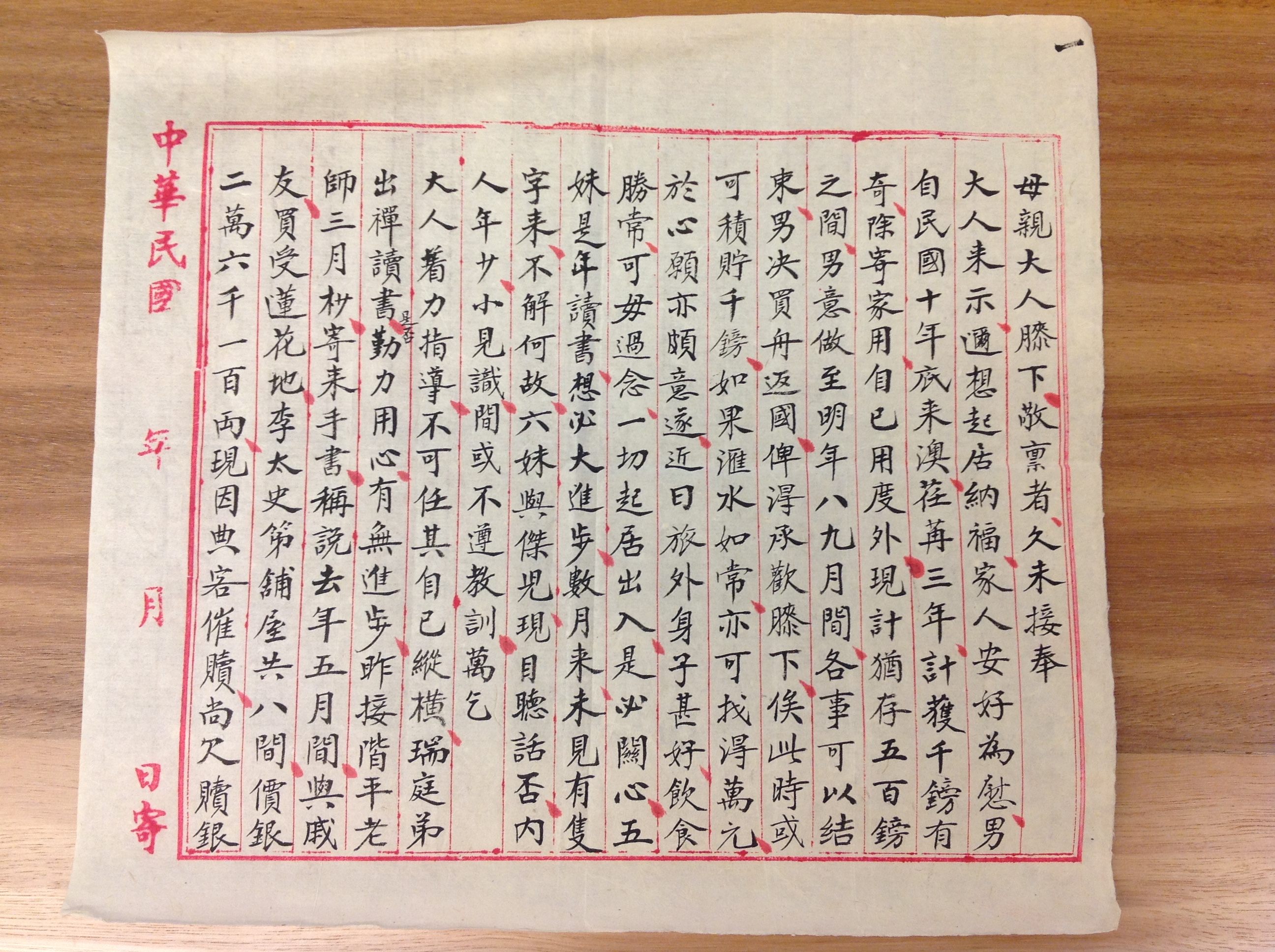
Remittances to family in the villages were a significant part of the lives of Chinese people in Australia before 1949. Early gold rush period remittances may have been in gold (dust then coin) but by the 20th century, bank drafts were more common. In such cases, a store owned by people from a related district collected individual remittances from its customers and if required a letter was written to the family by the store’s clerk to accompany the payment. When the Bank of China began to take over all remittances after 1949 it issued a standard form letter to accompany remittances that may have been modelled on that created by store scribes. Such a letter had 5 points: best wishes, write more often, let me know when received, have received your letter & tell how to spend the money in another letter.
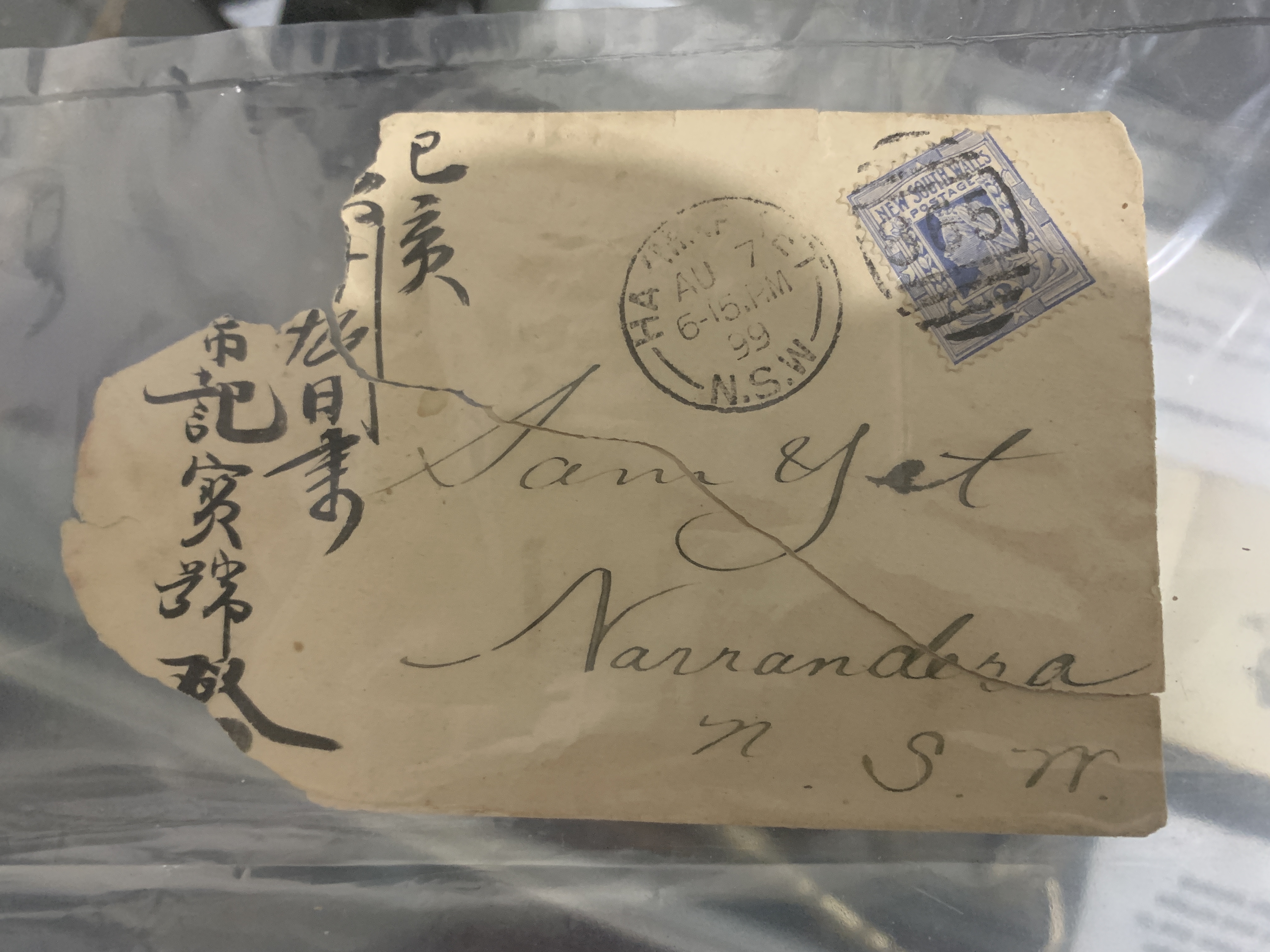
The Kwong War Chong at 84 Dixon St, Haymarket Sydney, for example, charged a small commission on each remittance and consolidated them into a single draft drawn on the English, Scottish and Australian Bank in pounds sterling. The draft was then sent to the Hong Kong branch of the Kwong War Chong, where it was converted to Hong Kong dollars and then into Chinese dollars for the money to be sent to the Zhongshan County capital Shekki. The store’s branch in Shekki then distributed the money to the families, either by their collecting it or by it being delivered to the villages by the firm’s clerks. A receipt, which included a letter back to Sydney, would be signed and returned to the shop in Dixon St, where it was set up on a rack in the front window for people to collect. This was the system used by most Chinese men working in Australia with small amounts to remit. It was a system that relied on family-like connections among people from the same village or locality. Something banks could not offer.
Despite this, elements of mistrust could be present. A remittance customer once complained that his family had not received their money and accused Phillip Lee Chun of stealing the remittance. Phillip Lee Chun was sitting outside his shop at 84 Dixon St one evening, “taking the air” when, according to his son Norman Lee, he was suddenly struck on the head by a piece of “two by four”. The man later apologised when his family sent word that they had received the money.[1]
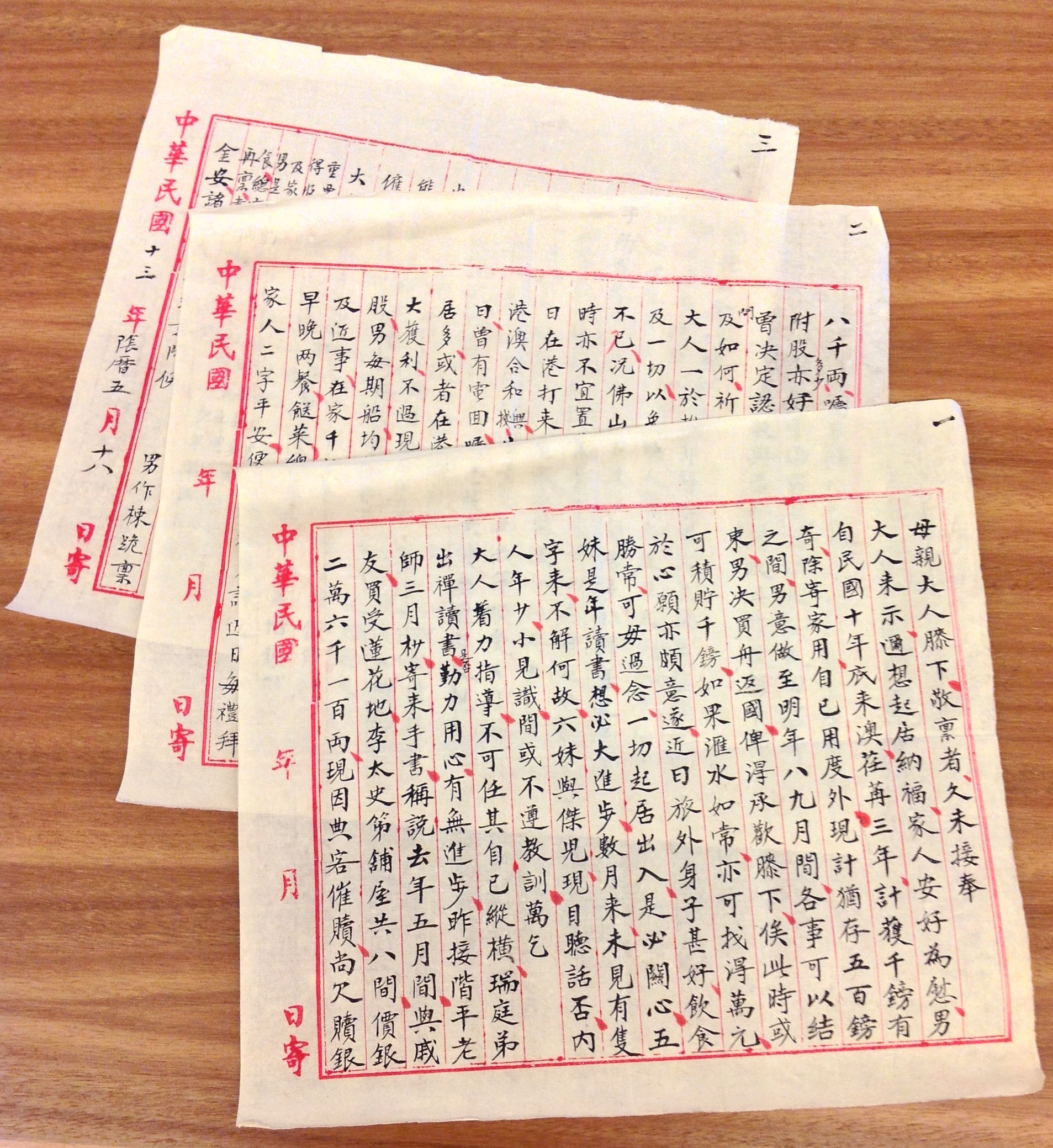
Remittances are closely connected with the letters that accompanied them. These letters are known as qiaopi and few survive in Australia.
[1] Interview Norman Lee, Sydney, 25 September 1997 (5), Michael Williams, Returning home with glory: Chinese villagers around the Pacific, 1849 to 1949 (榮歸故里:太平洋地區的中國僑鄉 1849–1949), Hong Kong University Press, Hong Kong, 2018.
For a comprehensive and fascinating account of the remittance system see: Dear China: Emigrant Letters and Remittances, 1820–1980 by Gregor Benton and Hong Liu, University of California Press, 2018.
Examples of remittances
"Ack Goon placed a brown paper packet, which he said contained 150 sovereigns, in the box and paid witness £1 10s., the ordinary commission for the transmission of gold at the rate of 1 per cent."
Barrier Miner, Tuesday 5 January 1909, p.3.
%2C%20Wing%20On%20Co%20Ltd%2C%20Hong%20Kong.jpg?2025-07-10T07:48:26.362Z)