Gardeners hut couplet
Date Published

: Taishanese/related dialect
: Ely Finch
乍聽雞鳴思樂境
Upon hearing the cries of hens, I think of the realm of joy;
一耷(聞)雀喊惱鰥居
(but) when I hear the calls of birds, I rue the bachelor's life
Chinese Writing on wall inside hut, East side.
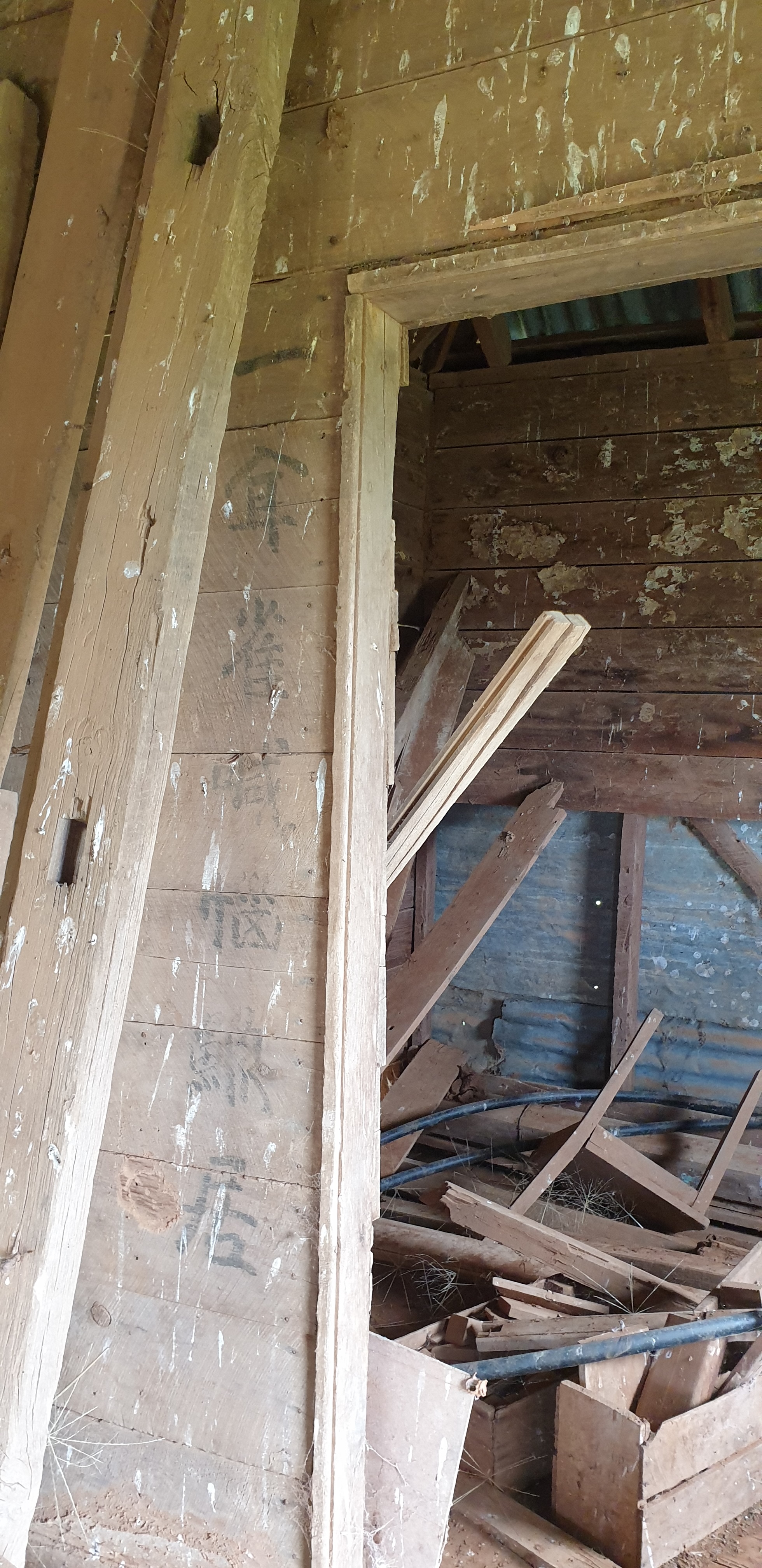
Chinese Writing on wall inside hut, West side.
Transcription into standard characters (noting that the vulgar characters do serve a purpose, by pointing to a colloquial sense):
乍聽雞鳴思樂境
一聞雀喊惱鰥居
Explanation and translation:
This door couplet is dirty double entendre in the See Yip language, which constitutes a lament couched in crude humour.
Roughly translated, the harmless superficial sense is "Upon hearing the cries of hens, I think of the realm of joy; (but) when I hear the calls of birds, I rue the bachelor's life".
The dirty primary sense, again roughly translated, is "Upon hearing the cries of hens, my thoughts turn to the joyful realm that is the brothel and the cries/moans of prostitutes ("hen" being a synonym of "prostitute"); (but) when I smell phallic saltiness, I rue the bachelor's life".
There are four characters that this double sense in the See Yip language hinges on:
雞 1. hen(s) 2. prostitute(s)
聞 1. to hear 2. to smell
雀 1. bird(s) 2. a common rude word for "penis(es)" (see attached excerpt on swearwords from a work on the Xinhui/Sun Wui dialect of the See Yip language "新会方言俗语钩沉")
喊 1. to call (as a bird may) 2. homophone or semi-homophone of 鹹 "to be salty"
Some of these senses will be quite unfamiliar to speakers of other Chinese languages, but they are perfectly standard in the See Yip language. For example, the last character could be used in such sentences as "喊做瑪麗窮個女仔來誒咯" "The girl named Mary is here" and "窮乃雀喊緊" "Those birds are calling".
Translator: Ely Finch