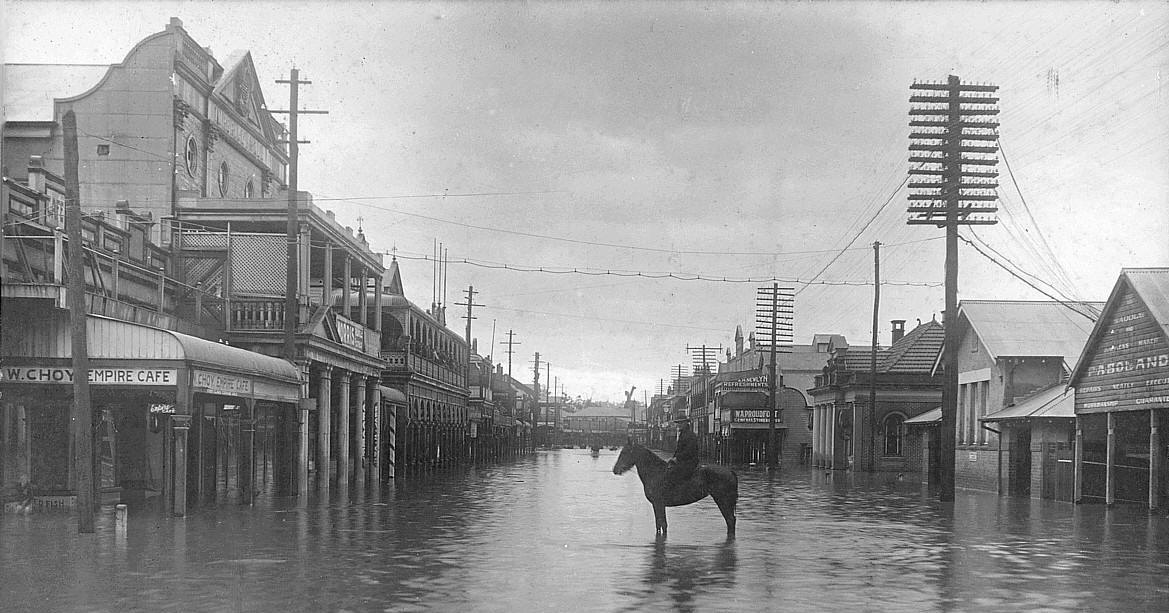
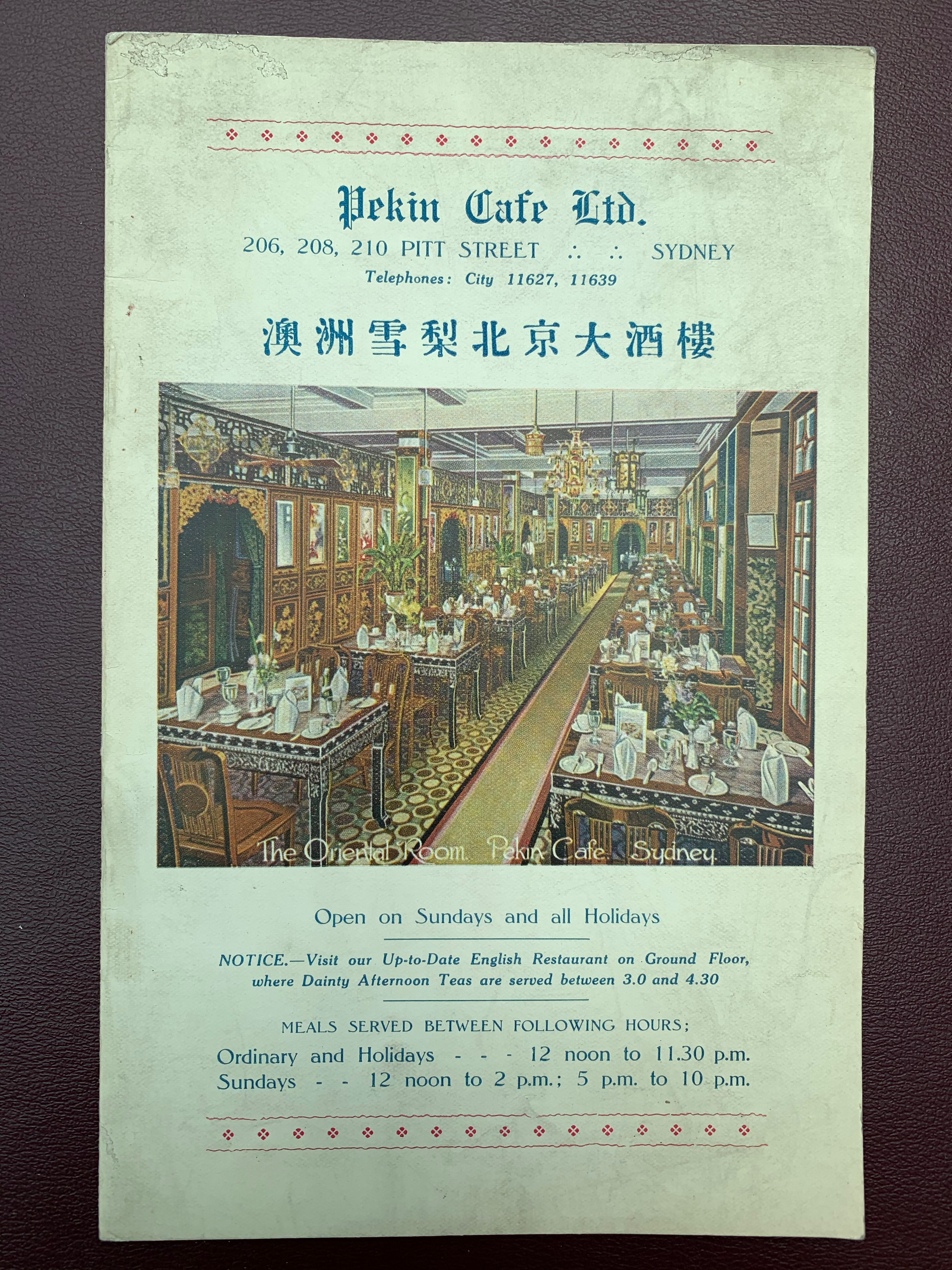
Pekin Cafe Menu
Date Published
: cusine, cafes / restaurants
: Sydney
: Sydney
: 1919 to 1927
"The Pekin Cafe at 206 Pitt-street, which is now open for meals in both European and Chinese style of cookery, is certainly an attractive exotic in our midst. The whole of thc partitions, of carved and decorated wood, as well as the furniture inlaid with mother-o'-pearl, have been imported from China. Each room is decorated in the Chinese style, and the embroidered pictures alone are worthy of many visits."
"The cafe was formally opened on Monday night, when many prominent society and business people of Sydney were the guests of Messrs. Samuel Wong, Lew Hey Darn, Fong Chee, and W. Sheekin, the proprietors. Mr. D. Levy, Speaker of the Legislative Assembly, was in the chair, and warmly congratulated the management on the enterprise. Mr. J. A. Chuey proposed the health of our Parliaments, while other speakers included Mr. D. R. Hall, Senator Bakhap, and Dr. J. Young."
Sunday Times, 28 September 1919, p.3.
While Chop Suey has now become seen as a simple dish, in the 1920s, the Pekin Cafe introduced it as a modern style of Chinese cuisine with many variations. As historian Mei-Fen Kuo relates:
"From 1900 to 1960, chop suey was one of the most popular dishes in the United States. In 1917,Yee Gee (as known as Yee Wing) opened the first chop suey house in Sydney, known as the Shanghai Café, catering for chop suey as a supper after going to the theatre. Although the Pekin Café was not the first restaurant introducing chop suey to Australia, it was important for how it represented chop suey as a ‘cosmopolitan’ food. At the opening of the Pekin Café, Samuel Wong introduced chop suey’s colorful history, highlighting it as a fashionable dish crossing cultures and nations.”
The Pekin Café in Sydney: enterprising Chinese Australians and cosmopolitan sociability in the early twentieth century - Dr. Mei-fen Kuo
Abstract: By focusing on the case of the Pekin Café in Sydney, this paper investigates the relationship between consumption, sociability and nationalism of the ChineseAustralian community in the early twentieth century. The paper examines the development of the Pekin Café in Sydney as a pleasant example of how Chinese Australians learned to establish a new style of enterprise in their urban life. By analyzing the connection between the Pekin Café and the Chinese nationalists, the second part of the paper demonstrates that the consumer culture of the Chinese diaspora community not only refers to the process of exchanging money for goods and services, but also to the experience of ethnic identity formation and of community organization. The paper argues that café sociability matters as a way to understand how Chinese Australians innovated new sociability to reshape their enterprise, social relationship and identity. Beyond kinship obligations and fraternal alliances, the organizing efforts of Chinese-Australian merchants constructed new spaces in which friendship, ethics, good citizens and gastronomy merged in a new sociability of Chinese diaspora community life.
Kuo, Mei-fen (2018). The Pekin Café in Sydney: consuming nationality and enterprising Chinese Australians in the early twentieth century. Conference of History of Consumer Culture: Objects, Desire and Sociability, Tokyo, Japan, 23-25 March, 2017. Tokyo, Japan: Gakushuin University.
Pekin Cafe Menu: SLNSW: De Villentroy family -- papers, 1886-1986, Pekin Café Menu – 206-210 Pitt St., c.1920s, [miscellaneous folder] MSS 5932.
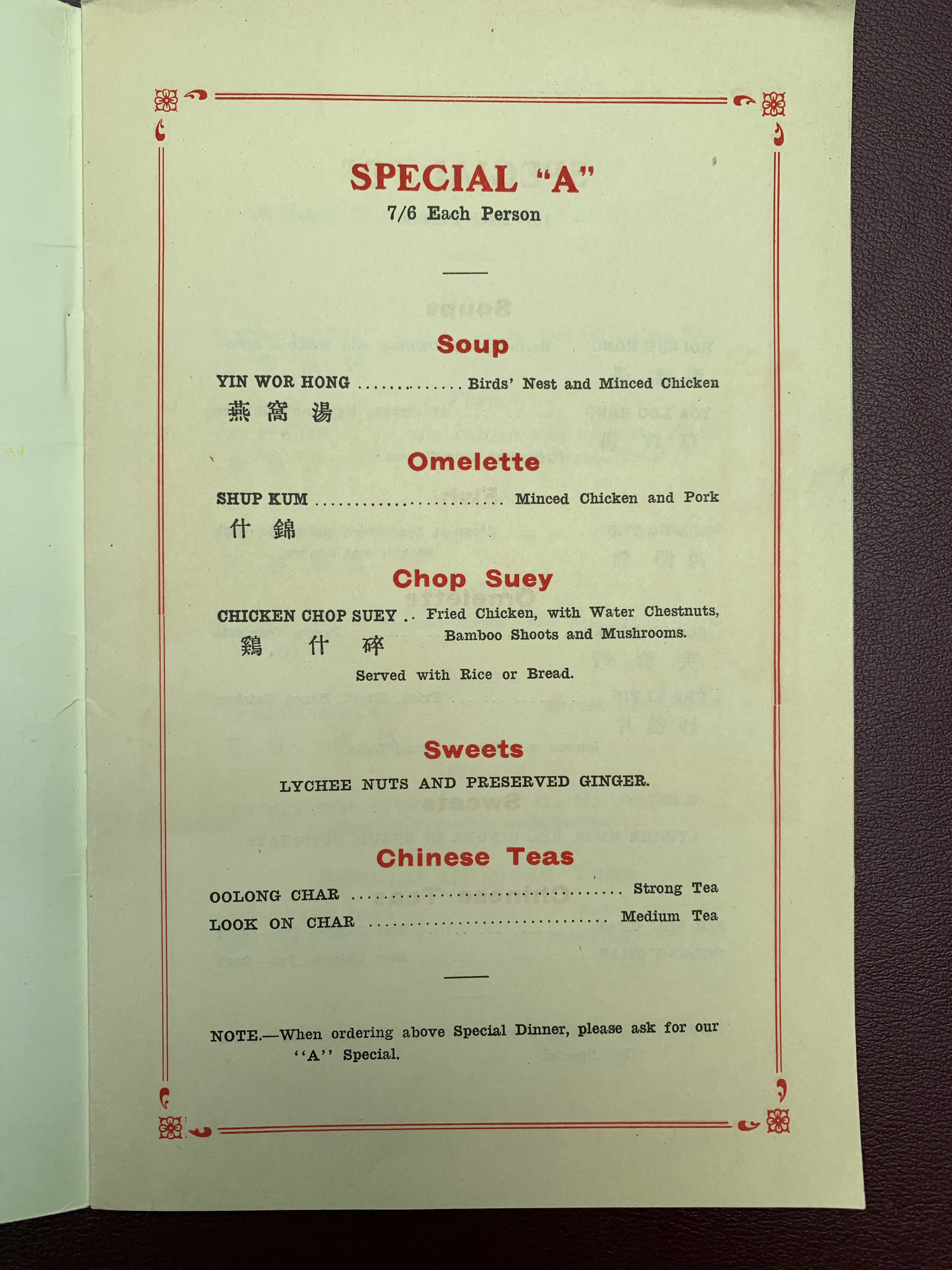
Pekin Cafe Menu
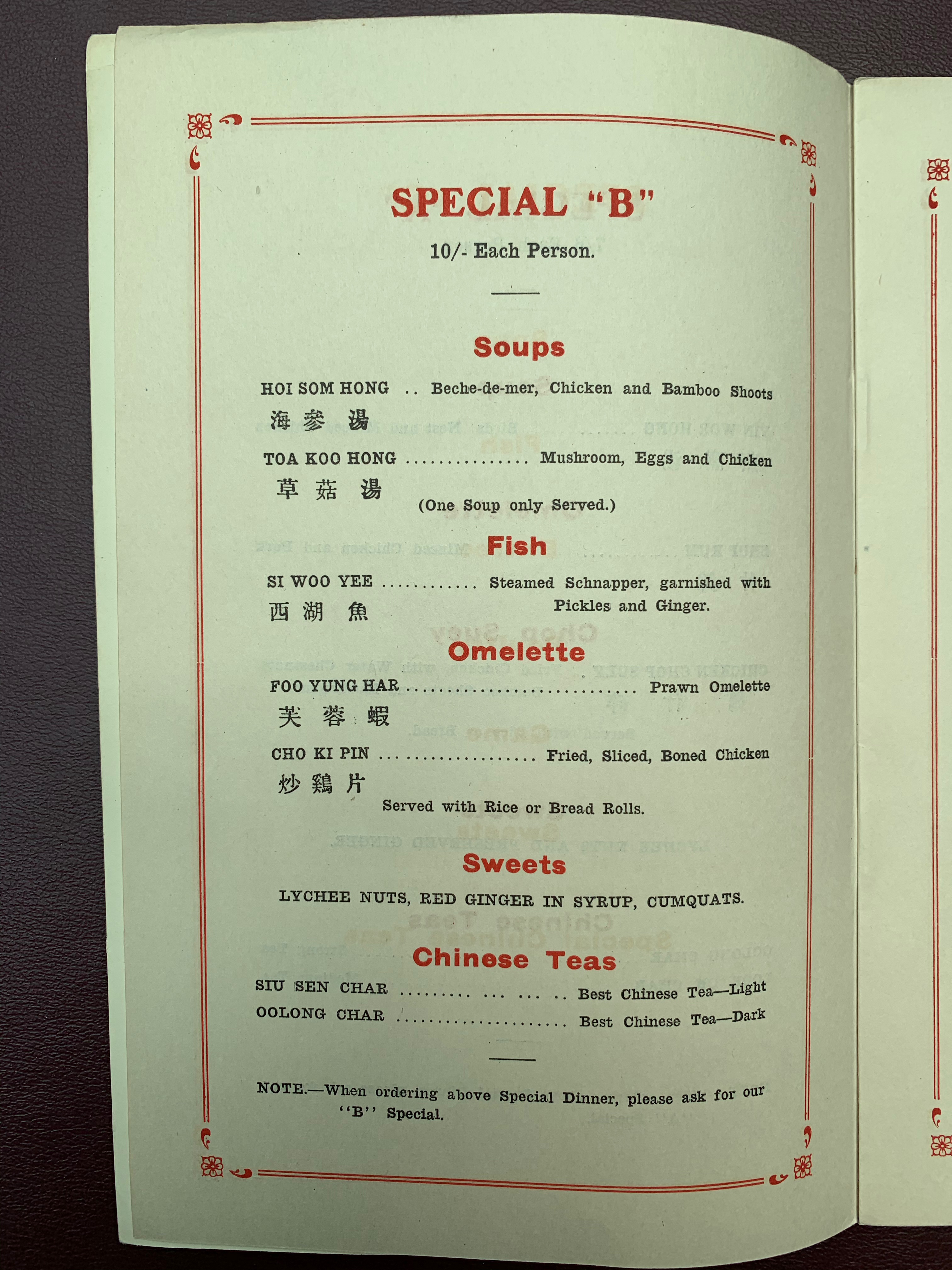
Pekin Cafe Menu
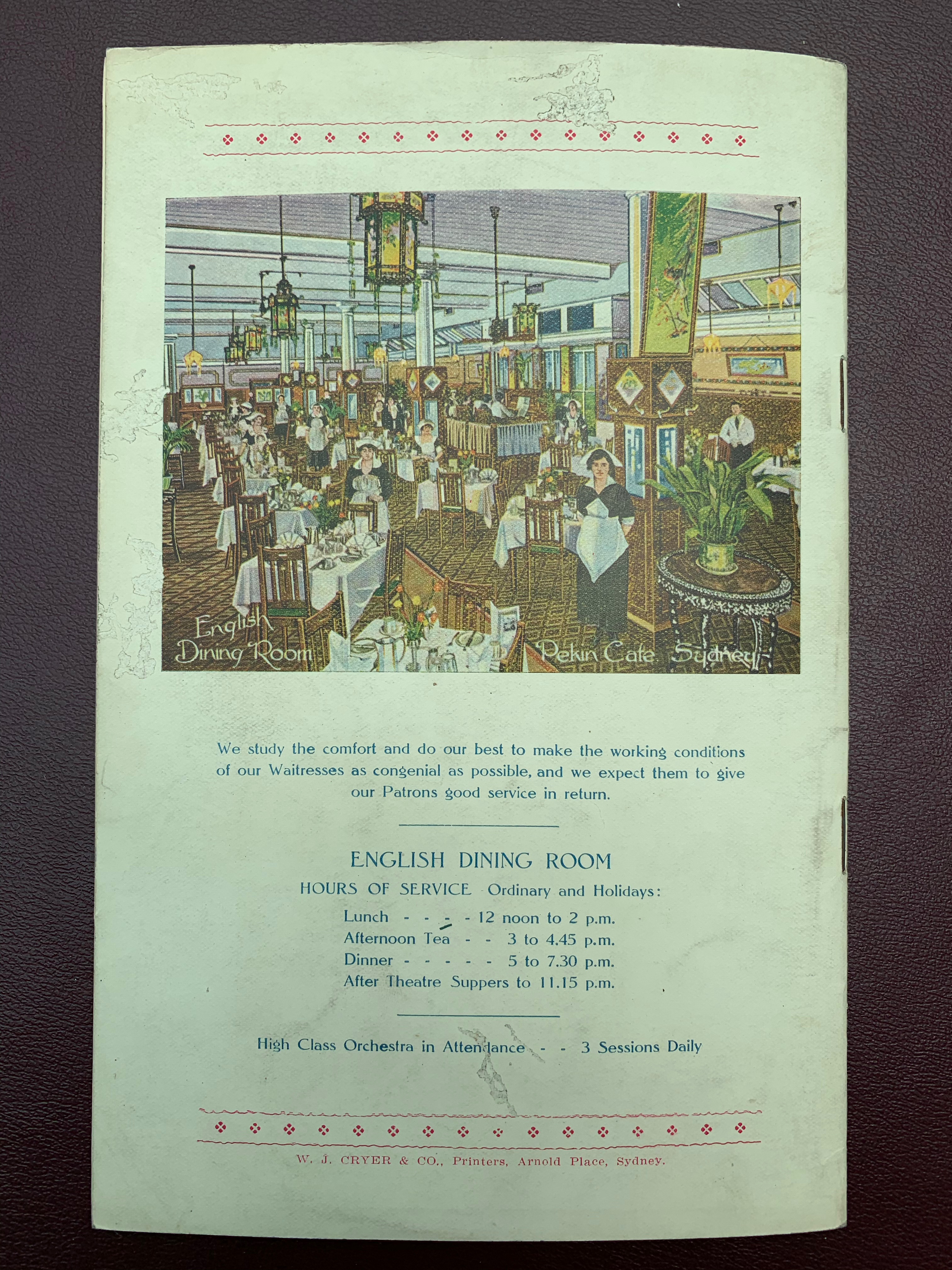
Pekin Cafe Menu