
Bilingual mining license notice, NZ
Date Published
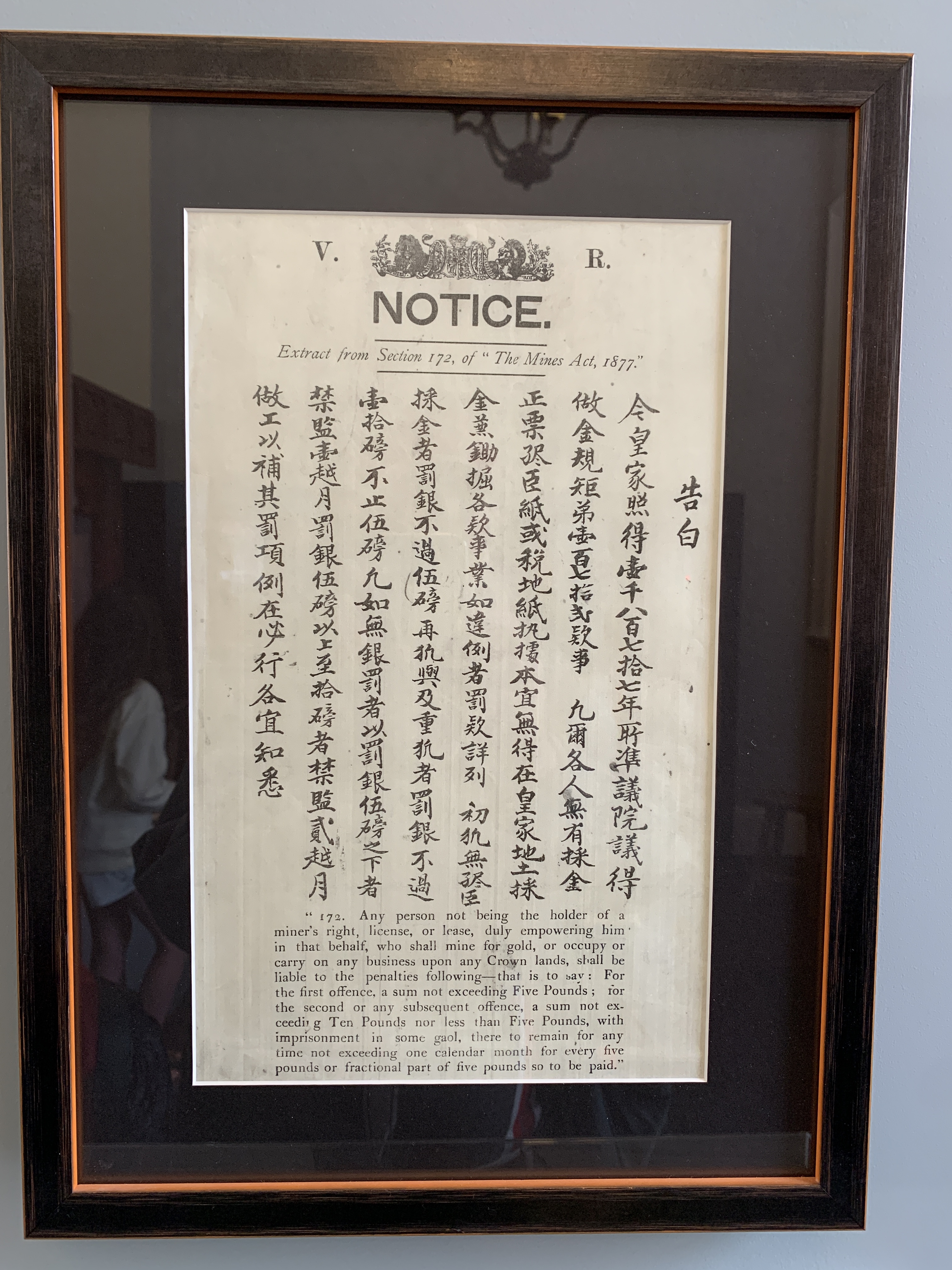
: Traditional
: Scattered Legacy
According to the authority of the Queen’s Government,
in the year 1877 the Parliament passed a law titled The Mines Act, 1877.
It states that all persons without a miner’s right, lease, or mining permit
who dig, wash, or extract gold from the ground on Crown land
shall be punished.
First offenders shall be fined not more than five pounds.
If the fine cannot be paid, the offender shall be imprisoned
for a term not exceeding one month.
Those who again offend, or violently resist an officer,
shall be further punished with a fine not exceeding ten pounds,
and if unpaid, imprisonment for not more than two months.
All are hereby notified not to mine for gold on Crown lands
without the proper licence or permit,
so as to avoid punishment and disgrace.
Notes
The term 「皇家地」 literally means “the Queen’s land” or “Crown land.”
「金臺」 or 「採金」 refers to digging or panning for gold.
「罰銀」 means “fine in silver (money).”
「禁監」 indicates imprisonment.
The structure follows Qing-era bureaucratic Chinese, using formal legal diction rather than vernacular.
Such notices were often posted in Chinese near mining camps in Victoria and New South Wales to warn unlicensed Chinese miners about penalties for illegal gold digging.
The English is of the original Act rather than a translation of the Chinese.